
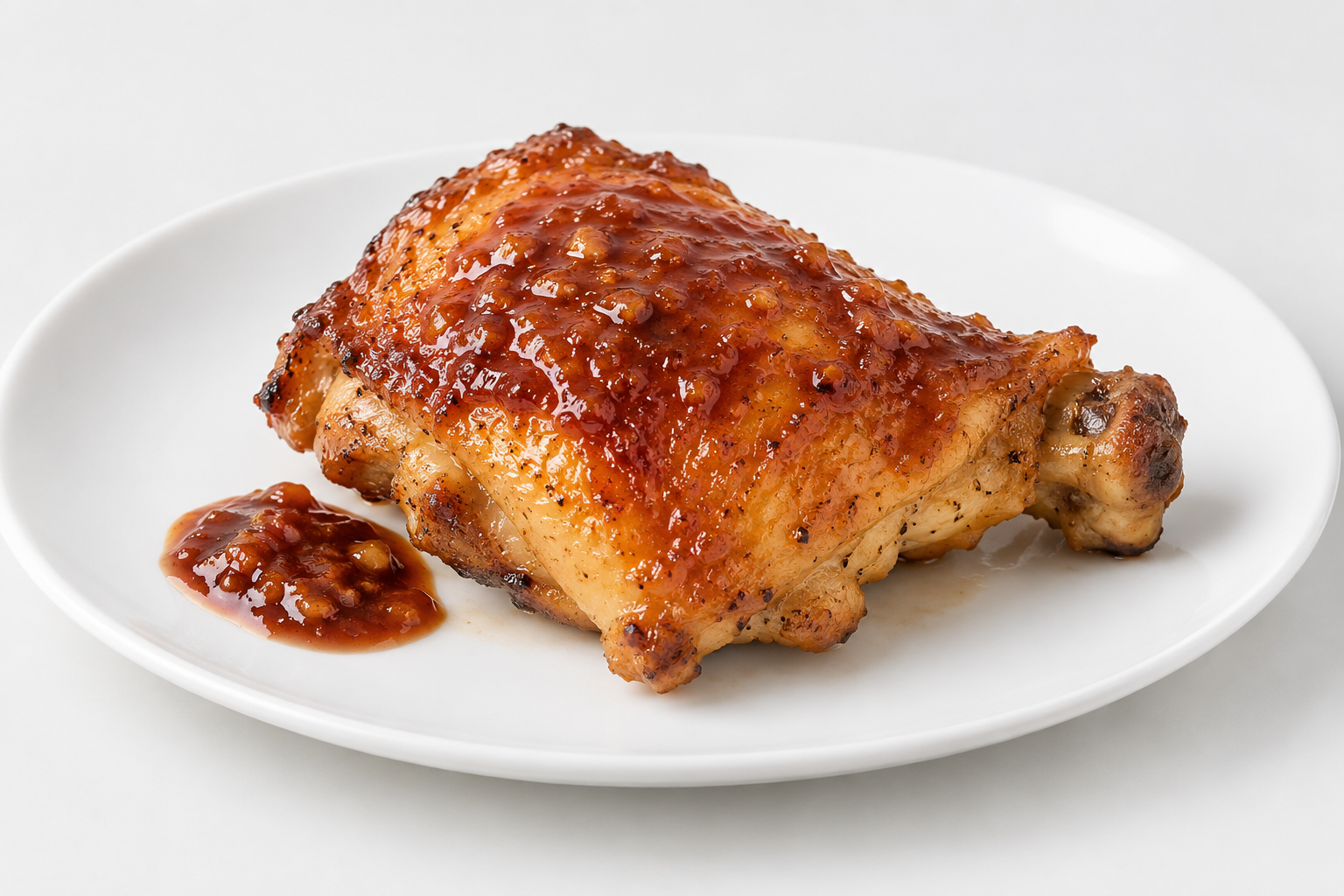
Monkey Gland Chicken
- Yield
- 4 portions; approximately 1000 g chicken plus 450 g sauce
February 27, 2026 · Version 1 · Main Course
Sweet, tangy, umami-rich South African steakhouse-style sauce glazed over crisp-skinned chicken. Yield: 4 portions. Roast to the source internal endpoint of 74 C.
Preparation
Scaling basis: Chicken Thigh · 1000 g
PHASE A — SEASON AND REST
Ingredient Uses
-
- Quantity
- 1000 g
- Scaling
- 100.00%
-
- Quantity
- 12 g
- Scaling
- 1.20%
-
- Quantity
- 3 g
- Scaling
- 0.30%
Method
- Pat chicken very dry (skin included).
- Season evenly with salt and pepper.
- Rest 20–30 min at room temperature.
Technique Applications
| Technique | Controls | Purpose |
|---|---|---|
| Salting | 12 g salt; 1000 g chicken; 20–30 min rest | Season evenly before searing. |
Principles
- Skin dehydration — Dry skin supports the later browning step.
Phase Outputs
| Key | Phase Output | Description |
|---|---|---|
| seasoned-chicken | Seasoned chicken thighs | Dried, seasoned chicken after its short rest. |
PHASE B — SEAR AND ROAST
Ingredient Uses
-
- Quantity
- 20 g
- Scaling
- 2.00%
Method
- Preheat oven to 200 C.
- Heat a heavy oven-safe pan over medium-high heat and add oil.
- Place chicken skin-side down; press lightly for full contact.
- Sear 6–8 min until deeply golden and fat rendered.
- Flip and transfer pan to oven.
- Roast until thickest piece reaches 74 C (about 12–18 min, depending on size).
- Rest 5–10 min before glazing.
Technique Applications
| Technique | Controls | Purpose |
|---|---|---|
| Searing | Skin-side down for 6–8 min | Brown the skin and render its fat. |
| Oven roasting | 200 C oven; 74 C internal endpoint; about 12–18 min | Finish chicken without extending beyond its endpoint. |
Principles
- Maillard reaction — A dry, hot sear builds savoury depth.
- Carryover cooking — Keep the authored rest and internal endpoint before glazing.
Phase Outputs Used
| Phase Output | Use |
|---|---|
| Seasoned chicken thighs | Use all of seasoned-chicken from PHASE A as directed above. |
Phase Outputs
| Key | Phase Output | Description |
|---|---|---|
| roasted-chicken | Rested roasted chicken | Seared and roasted chicken after resting. |
Dry skin and a hard sear build savoury depth. Rest after roasting before adding the glaze.
PHASE C — MONKEY GLAND SAUCE
May overlap: PHASE B — SEAR AND ROAST while the chicken roasts or rests.
Ingredient Uses
- Neutral oil or rendered chicken fat
Use neutral oil or rendered chicken fat, as the source allows. Source amount: as needed.
- Quantity
- As needed
- Scaling
- —
-
- Quantity
- 10 g
- Scaling
- 1.00%
-
- Quantity
- 10 g
- Scaling
- 1.00%
-
- Quantity
- 150 g
- Scaling
- 15.00%
-
- Quantity
- 120 g
- Scaling
- 12.00%
-
- Quantity
- 40 g
- Scaling
- 4.00%
-
- Quantity
- 20 g
- Scaling
- 2.00%
-
- Quantity
- 20 g
- Scaling
- 2.00%
-
- Quantity
- 15 g
- Scaling
- 1.50%
-
- Quantity
- 15 g
- Scaling
- 1.50%
-
- Quantity
- 3 g
- Scaling
- 0.30%
-
- Quantity
- 2 g
- Scaling
- 0.20%
-
- Quantity
- 60 g
- Scaling
- 6.00%
Method
- Warm a small splash of oil (or rendered chicken fat) in a saucepan over medium heat.
- Sauté garlic and ginger 30–60 s until fragrant.
- Add remaining ingredients.
- Simmer gently 5–8 min until glossy and slightly thickened (sauce should cling, not run).
- Adjust to taste: more vinegar for tang, more chutney/sugar for sweetness, more soy/Worcestershire for depth.
Technique Applications
| Technique | Controls | Purpose |
|---|---|---|
| Simmering | Gentle simmer for 5–8 min | Make a glossy sauce that clings. |
Principles
- Acid balance — Vinegar balances the chutney and ketchup sweetness.
Phase Outputs
| Key | Phase Output | Description |
|---|---|---|
| monkey-gland-sauce | Monkey gland sauce | Warm glossy sauce ready for glazing. |
Gentle simmering reduces water and concentrates the source sugar, acid, and salt balance into a clinging glaze.
PHASE D — GLAZE AND SERVE
Method
- Brush warm sauce over rested chicken, or return chicken to the pan and glaze over low heat 2–3 min.
- Serve with extra sauce on the side.
Technique Applications
| Technique | Controls | Purpose |
|---|---|---|
| Glazing | Brush on warm, or coat over low heat for 2–3 min | Glaze rested chicken just before service. |
Phase Outputs Used
| Phase Output | Use |
|---|---|
| Rested roasted chicken | Use all of roasted-chicken from PHASE B as directed above. |
| Monkey gland sauce | Use all of monkey-gland-sauce from PHASE C as directed above. |
FAILURE MODES
| Symptom | Likely cause | Corrective action |
|---|---|---|
| Pale, rubbery skin. | Skin not dried; pan not hot enough; poor skin contact. | Pat very dry, preheat pan, press skin-side down, and don’t move chicken until it releases. |
| Sauce is thin and watery. | Under-reduced or too much water added. | Simmer longer at a gentle bubble until it coats a spoon; add water only to control thickness. |
| Sauce tastes flat or cloyingly sweet. | Not enough acid/salt/umami to balance chutney/ketchup. | Add vinegar for brightness and soy/Worcestershire for depth; simmer 1–2 min and re-taste. |
| Chicken is dry. | Overcooked beyond 74 C or held hot too long before serving. | Pull at 74 C, rest briefly, and glaze just before serving. |