
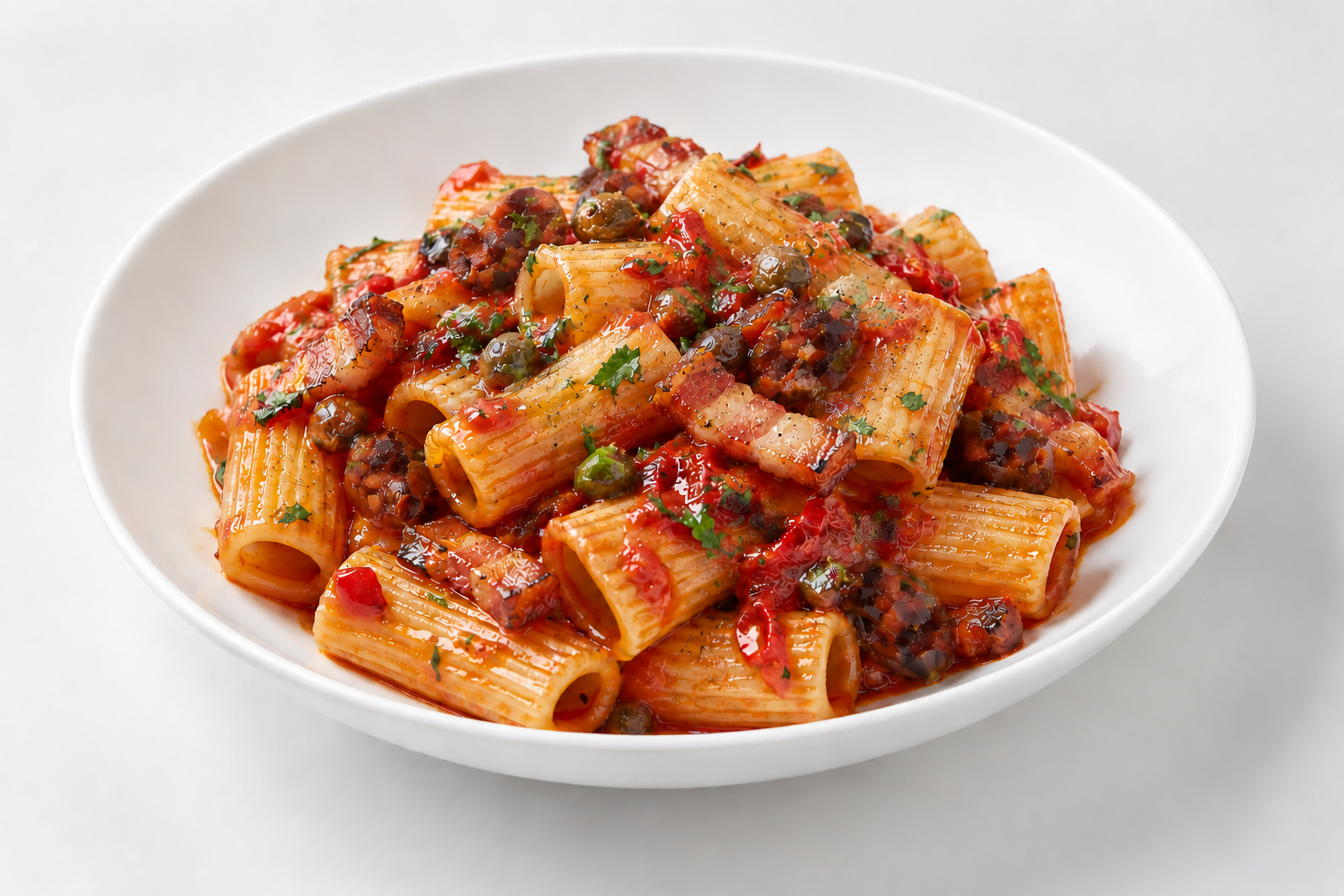
Guanciale, Olive & Chili Pasta Sauce
- Yield
- 2 portions
February 19, 2026 · Version 1 · Sauce
Rendered guanciale, olives, and tomato coat pasta in a glossy, lightly spicy sauce.
Preparation
Scaling basis: Guanciale · 150 g
PHASE A — RENDER GUANCIALE AND AROMATICS
Ingredient Uses
- Guanciale
Cut into lardons and start in a cold pan.
- Quantity
- 150 g
- Scaling
- 100.00%
- Garlic
Slice thinly.
- Quantity
- 8 g
- Scaling
- 5.33%
- Fresh red chili
Slice.
- Quantity
- 5 g
- Scaling
- 3.33%
- Black pepper
Season the aromatic fat.
- Quantity
- 2 g
- Scaling
- 1.33%
Method
- Place the guanciale in a cold, wide pan. Bring to medium heat and render slowly for 6–8 min, until the fat releases and the meat is golden and lightly crisp.
- Remove the guanciale with a slotted spoon and reserve it. Keep the rendered fat in the pan.
- Gently sauté the sliced garlic, chili, and black pepper in the rendered fat until fragrant, without browning the garlic.
Technique Applications
| Technique | Controls | Purpose |
|---|---|---|
| Fat rendering | Cold pan; medium heat; 6–8 min | Release pork fat without scorching the guanciale. |
Principles
- Fat as flavour carrier — The rendered pork fat carries the garlic and chili aromatics into the sauce.
Phase Outputs
| Key | Phase Output | Description |
|---|---|---|
| rendered-guanciale | Rendered guanciale | Crisped meat reserved for the final toss. |
| aromatic-fat | Aromatic fat | Rendered pork fat carrying garlic, chili, and black pepper. |
PHASE B — BUILD THE TOMATO SAUCE
Ingredient Uses
- Black olives
Chop.
- Quantity
- 80 g
- Scaling
- 53.33%
- Capers
Rinse.
- Quantity
- 15 g
- Scaling
- 10.00%
- Canned whole tomatoes
Crush before adding.
- Quantity
- 400 g
- Scaling
- 266.67%
Method
- Add the olives and capers to the aromatic fat and sauté for 1–2 min.
- Add the crushed tomatoes, bring to a steady simmer, and reduce for 10–15 min until thick and glossy.
- Taste before adjusting seasoning; the guanciale, olives, and capers may provide enough salt.
Technique Applications
| Technique | Controls | Purpose |
|---|---|---|
| Reduction | Steady simmer; 10–15 min | Concentrate the tomatoes until thick and glossy. |
Principles
- Salt balance — Guanciale, olives, and capers contribute substantial salt; taste before adding any more.
Phase Outputs Used
| Phase Output | Use |
|---|---|
| Aromatic fat | Cook the olives and capers in aromatic-fat before adding tomato. |
Phase Outputs
| Key | Phase Output | Description |
|---|---|---|
| tomato-sauce | Tomato sauce | Reduced tomato, olive, and caper sauce in aromatic pork fat. |
PHASE C — COOK PASTA AND EMULSIFY
Ingredient Uses
- Dried pasta
Use rigatoni or spaghetti; cook until al dente.
- Quantity
- 300 g
- Scaling
- 200.00%
- Water
Reserve about 60 g of the starchy pasta cooking water for the sauce.
- Quantity
- 60 g
- Scaling
- 40.00%
- Flat-leaf parsley
Chop for finishing.
- Quantity
- 10 g
- Scaling
- 6.67%
- Black pepper
Finish to taste.
- Quantity
- As needed
- Scaling
- —
Method
- Cook the pasta in heavily salted water until al dente and reserve about 60 g of its hot, starchy cooking water.
- Transfer the pasta to the tomato sauce with the reserved water. Return the guanciale to the pan.
- Toss vigorously until the fat, tomato, and starch form a cohesive glaze. Add small increments of hot pasta water if the sauce separates.
- Finish with parsley and black pepper; serve immediately.
Technique Applications
| Technique | Controls | Purpose |
|---|---|---|
| Emulsification | About 60 g hot pasta water; vigorous tossing | Bring rendered fat, tomato, and starch-rich water into a cohesive glaze. |
Principles
- Starch-water emulsification — Starchy cooking water and agitation bind the fat and tomato around the pasta.
Phase Outputs Used
| Phase Output | Use |
|---|---|
| Tomato sauce | Toss the cooked pasta through tomato-sauce. |
| Rendered guanciale | Return all of rendered-guanciale during the final toss. |
FAILURE MODES
| Symptom | Likely cause | Corrective action |
|---|---|---|
| Sauce feels greasy and separated | Too little pasta water or inadequate tossing | Add small increments of hot pasta water and toss vigorously. |
| Sauce tastes flat | Tomatoes were under-reduced | Simmer longer to concentrate their flavour. |
| Guanciale is tough or burnt | Rendering heat was too high | Start in a cold pan and render gently. |