
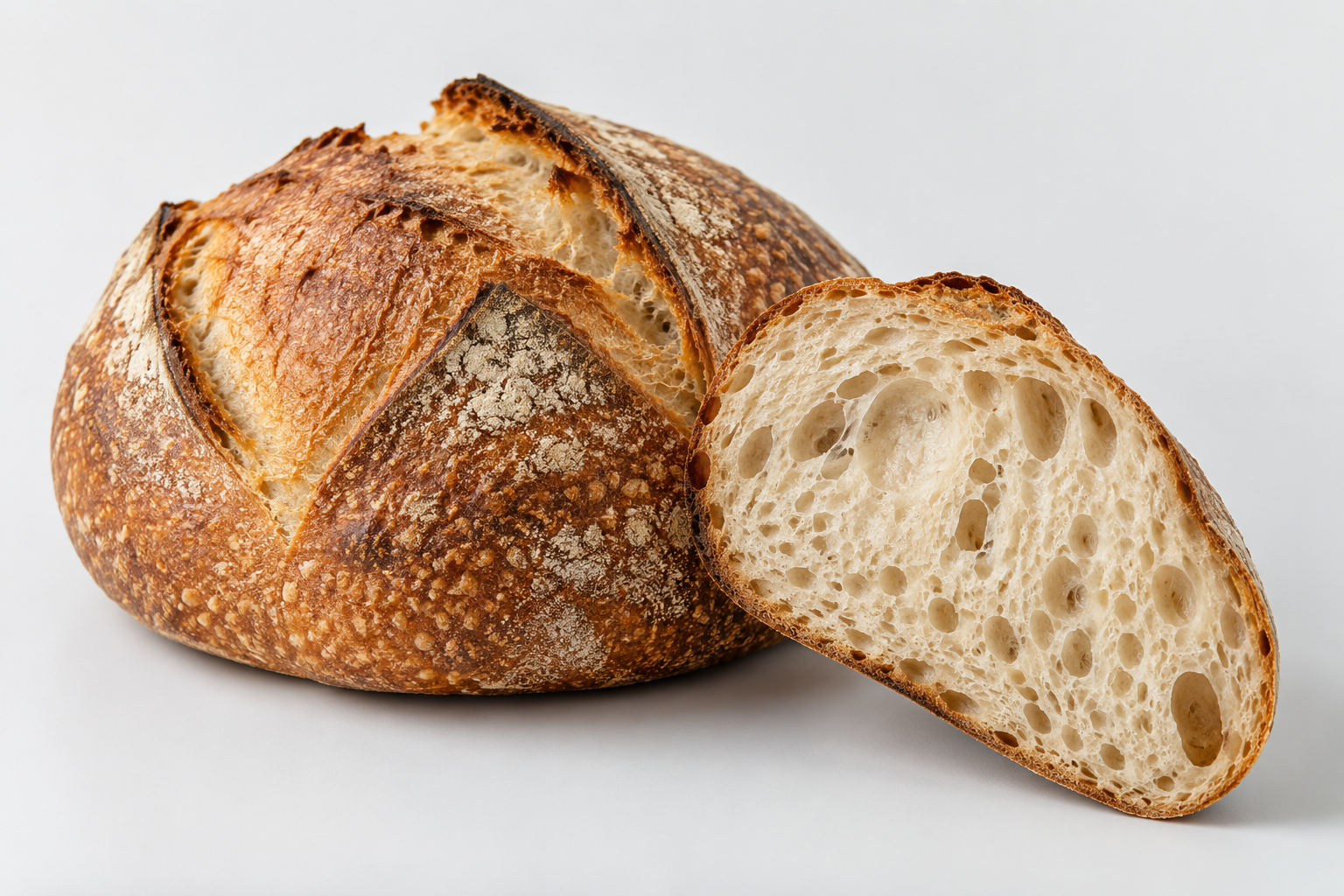
Sourdough Bread
- Yield
- 2 loaves (~900 g each)
February 23, 2026 · Version 1 · Side Dish
Lean naturally leavened bread with staged fermentation, folds, and covered baking.
Preparation
Scaling basis: Bread flour · 1100 g
PHASE A — BUILD LEVAIN
Ingredient Uses
- Mature sourdough starter
Inoculate the levain.
- Quantity
- 20 g
- Scaling
- 1.82%
- Bread flour
Feed the levain.
- Quantity
- 100 g
- Scaling
- 9.09%
- Water
Hydrate the levain.
- Quantity
- 100 g
- Scaling
- 9.09%
Method
- Mix starter, flour, and water until homogeneous.
- Cover and ferment until expanded and active.
Technique Applications
| Technique | Controls | Purpose |
|---|---|---|
| Levain build | Ferment about 8 h at room temperature until expanded and active. | Produce ripe leaven. |
Principles
- Yeast and lactic acid bacteria fermentation — The culture produces gas and acidity.
Phase Outputs
| Key | Phase Output | Description |
|---|---|---|
| ripe-levain | Ripe levain | Active leaven for the dough. |
PHASE B — MIX AND DEVELOP DOUGH
Ingredient Uses
- Bread flour
Mix into the dough.
- Quantity
- 1000 g
- Scaling
- 90.91%
- Water
Use 600 g to hydrate the flour and reserve 40 g to dissolve salt.
- Quantity
- 640 g
- Scaling
- 58.18%
- Salt
Dissolve in the additional water.
- Quantity
- 20 g
- Scaling
- 1.82%
Method
- Combine water, ripe levain, and flour; cover and rest.
- Dissolve salt in the additional water, mix it into the dough, and perform three stretch-and-fold sets.
- Let the dough bulk ferment until visibly aerated.
Technique Applications
| Technique | Controls | Purpose |
|---|---|---|
| Autolyse | Rest flour and water 30 min to 4 h. | Hydrate flour before salt incorporation. |
| Folding | Perform 3 stretch-and-fold sets over 90 min. | Strengthen dough without intensive kneading. |
| Bulk fermentation | Ferment 2–3 h until visibly aerated. | Develop gas and dough structure. |
Principles
- Hydration ratio — Water proportion controls dough handling and crumb.
- Gluten development — Resting and folding develop structure.
- Salt control of fermentation — Salt affects fermentation timing.
Phase Outputs Used
| Phase Output | Use |
|---|---|
| Ripe levain | Dissolve ripe-levain in the dough water. |
Phase Outputs
| Key | Phase Output | Description |
|---|---|---|
| bulk-dough | Bulk-fermented dough | Aerated dough ready to divide. |
PHASE C — SHAPE, PROOF, AND BAKE
Method
- Divide the dough into two, pre-shape, rest 30 min, shape, and proof 2–3 h at room temperature or overnight in the refrigerator.
- Preheat a lidded casserole at 240 C for at least 20 min.
- Bake each scored loaf covered, uncover for the final 10 min, and cool completely before slicing.
Technique Applications
| Technique | Controls | Purpose |
|---|---|---|
| Staged baking | Bake covered then uncover for the last 10 min; total about 40 min at 240 C. | Allow spring before browning the crust. |
Principles
- Steam-assisted oven spring — Covered baking delays crust setting during expansion.
- Maillard reaction — The uncovered finish browns the crust.
Phase Outputs Used
| Phase Output | Use |
|---|---|
| Bulk-fermented dough | Divide bulk-dough, pre-shape, rest, shape, proof, and score. |
FAILURE MODES
| Symptom | Likely cause | Corrective action |
|---|---|---|
| Dense loaf | Levain or bulk fermentation was insufficient. | Extend fermentation and confirm levain activity. |
| Flat dough | Gluten was weak or dough overproofed. | Add a fold set and shorten final proof. |
| Gummy crumb | Centre was underbaked or sliced hot. | Bake to about 98 C and cool fully. |