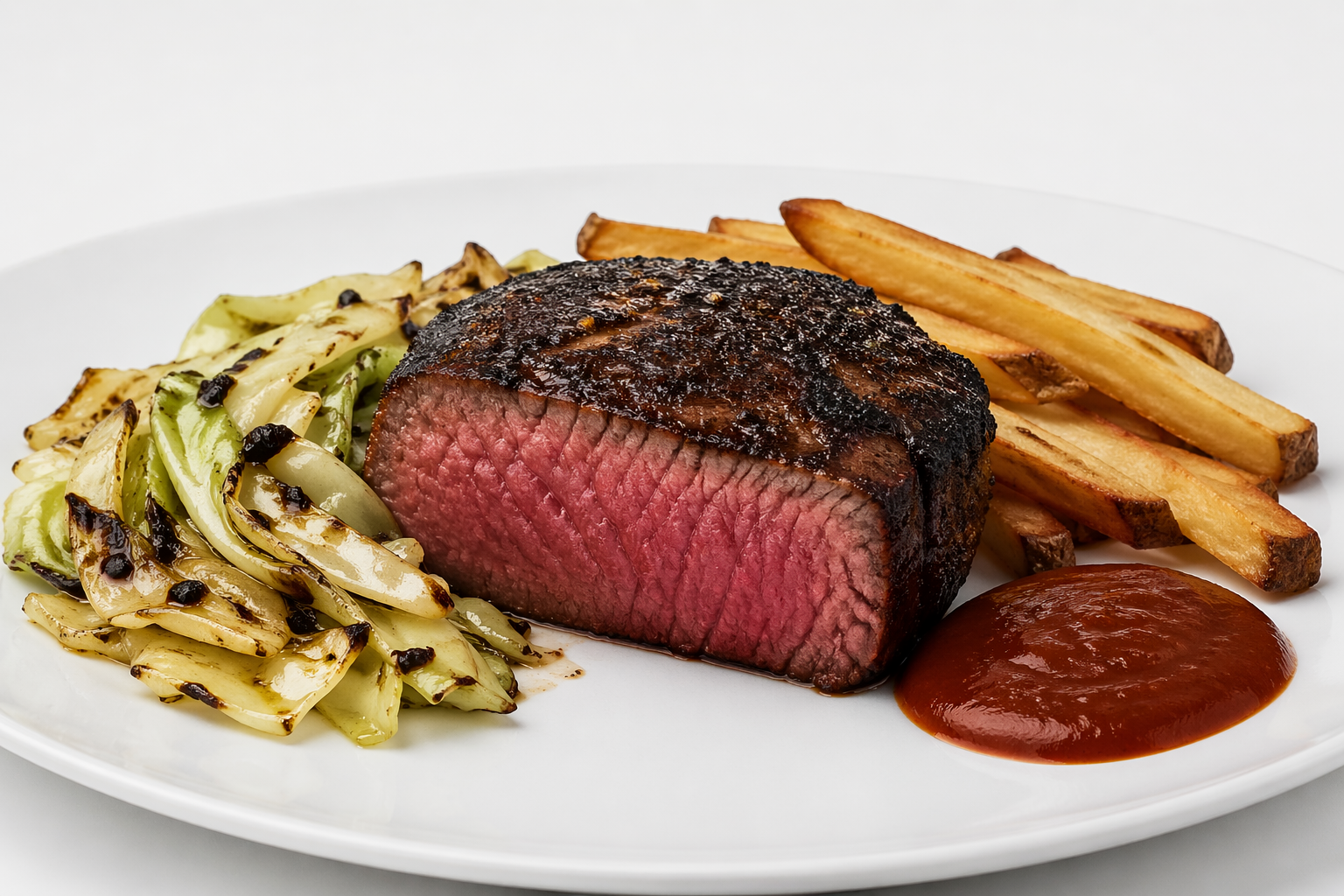
Primary Ingredient Basis: 650 g beef fillet = 100%
Service-timed steakhouse plate built around low-temperature reverse sear, charcoal crust, and staggered finishing.
PHASE A - GOCHUJANG SAUCE BASE (ADVANCE PREP)
Components
| Ingredient | Quantity | Scaling |
|---|---|---|
| Neutral oil | 15 g | 2.31% |
| Garlic, grated | 5 g | 0.77% |
| Ginger, grated | 5 g | 0.77% |
| Gochujang | 40 g | 6.15% |
| Soy sauce | 15 g | 2.31% |
| Rice vinegar | 20 g | 3.08% |
| Honey | 10 g | 1.54% |
| Worcestershire sauce (optional) | 3 g | 0.46% |
Method
- Heat neutral oil in a small pan over medium heat.
- Add garlic and ginger; cook 30 seconds until fragrant.
- Add gochujang and fry 20-30 seconds to bloom the paste.
- Stir in soy sauce, rice vinegar, honey, and Worcestershire if using.
- Simmer 1-2 minutes until smooth and lightly thickened.
- Cool and reserve for final service.
Timing
- 17:15-17:20 or earlier.
- Active time: about 5 minutes.
- Cool and hold until Phase F.
PHASE B - STEAK SEASONING & REVERSE SEAR
Components
| Ingredient | Quantity | Scaling |
|---|---|---|
| Beef fillet | 650 g | 100.00% |
| Kosher salt | 6 g | 0.92% |
Method
- Remove steak from refrigeration 45 minutes before service.
- Season evenly with kosher salt on all sides.
- Preheat oven to 110 C.
- Place steak on a rack set over a tray.
- Roast until internal temperature reaches 46-48 C.
- Remove and hold at room temperature while the hibachi is prepared.
Timing
- 17:30 Salt steak.
- 17:45 Steak into 110 C oven.
- 18:05-18:10 Pull at 46-48 C.
PHASE C - STEAKHOUSE FRIES (SOAK + FIRST FRY)
Components
| Ingredient | Quantity | Scaling |
|---|---|---|
| Potatoes | 500 g | 76.92% |
| Neutral frying oil | as needed | - |
Method
- Cut potatoes into thick steakhouse fries.
- Soak 20 minutes in cold water, then drain and dry thoroughly.
- Fry at 160 C for 5-6 minutes until cooked through but still pale.
- Drain and rest on a rack until final frying.
Timing
- 17:40 Cut and start soaking.
- 18:00-18:06 First fry.
- Hold on rack until Phase F.
PHASE D - HIBACHI CABBAGE
Components
| Ingredient | Quantity | Scaling |
|---|---|---|
| Baby red cabbages | 2 heads | - |
| Neutral oil | 10 g | 1.54% |
| Salt | 3 g | 0.46% |
| Rice vinegar | 15 g | 2.31% |
| Sesame oil | 5 g | 0.77% |
| Honey | 5 g | 0.77% |
| Sesame seeds (optional) | to finish | - |
Method
- Cut cabbages in half through the core.
- Lightly oil and salt the cut faces.
- Place cut-side down over very hot coals and char 3-4 minutes without moving.
- Flip and move to slightly cooler heat.
- Cook 3-4 minutes more until tender through the core.
- Remove and dress with rice vinegar, sesame oil, honey, and sesame seeds if using.
Timing
- 17:50 Light hibachi; let coals establish.
- 18:10 Cabbage onto hibachi.
- 18:14 Flip.
- 18:16 Off the fire; dress immediately.
PHASE E - HIBACHI SEAR & REST
Components
| Ingredient | Quantity | Scaling |
|---|---|---|
| Reverse-seared fillet (from Phase B) | 650 g | 100.00% |
| Neutral oil | 10 g | 1.54% |
| Butter | 20 g | 3.08% |
Method
- Pat steak dry and rub lightly with neutral oil.
- Sear over the hibachi 45-60 seconds per side.
- Rotate once per side if needed for even crust.
- Briefly sear the edges.
- Remove from the heat and add butter to coat.
- Rest 10 minutes before slicing.
Timing
- 18:16-18:18 Hibachi sear.
- 18:18-18:28 Rest.
- Keep slicing board and knife ready during the rest.
PHASE F - FINAL FRY & SAUCE FINISH
Components
| Ingredient | Quantity | Scaling |
|---|---|---|
| Par-cooked fries (from Phase C) | 500 g potatoes | 76.92% |
| Reserved sauce base (from Phase A) | 1 batch | - |
| Neutral frying oil | as needed | - |
| Butter | 20 g | 3.08% |
| Sesame oil | 5 g | 0.77% |
| Salt | to taste | - |
| MSG | pinch | - |
| Smoked paprika | pinch | - |
Method
- Fry potatoes at 190 C for 2-3 minutes until golden and crisp.
- Drain and season immediately with salt, MSG, and smoked paprika.
- Warm the reserved sauce base gently.
- Whisk in butter and sesame oil to finish the sauce.
Timing
- 18:20-18:23 Second fry during steak rest.
- 18:23-18:25 Warm and finish sauce.
- Hold both hot for plating.
PHASE G - SLICE, PLATE & SERVE
Components
| Ingredient | Quantity | Scaling |
|---|---|---|
| Rested steak (from Phase E) | 650 g | 100.00% |
| Charred cabbage (from Phase D) | 4 halves | - |
| Finished fries (from Phase F) | 1 batch | - |
| Finished gochujang sauce (from Phase F) | 1 batch | - |
| Celtic grey sea salt | to finish | - |
| Black pepper | to finish | - |
Method
- Slice steak across the grain.
- Season the cut faces lightly with finishing salt and black pepper.
- Plate steak with charred cabbage and fries.
- Serve gochujang sauce alongside.
Timing
- 18:28 Slice steak.
- 18:29 Build plates.
- 18:30 Serve.
STRUCTURAL NOTES
- Reverse sear reduces grey banding by bringing the fillet close to final temperature before the crusting step.
- Hibachi finishing adds radiant heat and smoke quickly enough to build crust without overshooting the interior.
- Brassicas tolerate a short hold well, so cabbage can leave the fire before the steak sear and still plate cleanly.
- Double frying separates starch cook-through from final dehydration, which improves exterior crispness.
- The run-sheet is normalized to land plating at 18:30; if the fillet is unusually thick, start Phase B 5-10 minutes earlier.
FAILURE MODES
-
Symptom: Pale or weak steak crust.
-
Likely cause: Surface moisture remained after the oven phase, or coals were not fully established.
-
Corrective action: Pat dry immediately before searing and wait for aggressive radiant heat before the hibachi finish.
-
Symptom: Fries turn limp before plating.
-
Likely cause: First fry did not dry enough internally, or the second fry started too early.
-
Corrective action: Rest the first fry on a rack, then hold the second fry until the steak is nearly ready to rest.
-
Symptom: Cabbage is burnt outside but rigid in the core.
-
Likely cause: Heat stayed too intense after the first char.
-
Corrective action: Move the cabbage to a slightly cooler zone after flipping and finish over moderated coals.
-
Symptom: Sauce tastes harsh or greasy.
-
Likely cause: Gochujang was under-cooked in the base, or butter and sesame oil were added over excessive heat.
-
Corrective action: Bloom the paste fully in Phase A and whisk in finishing fats only over low heat.