Primary Ingredient Basis: 250 g fresh mushrooms = 100%
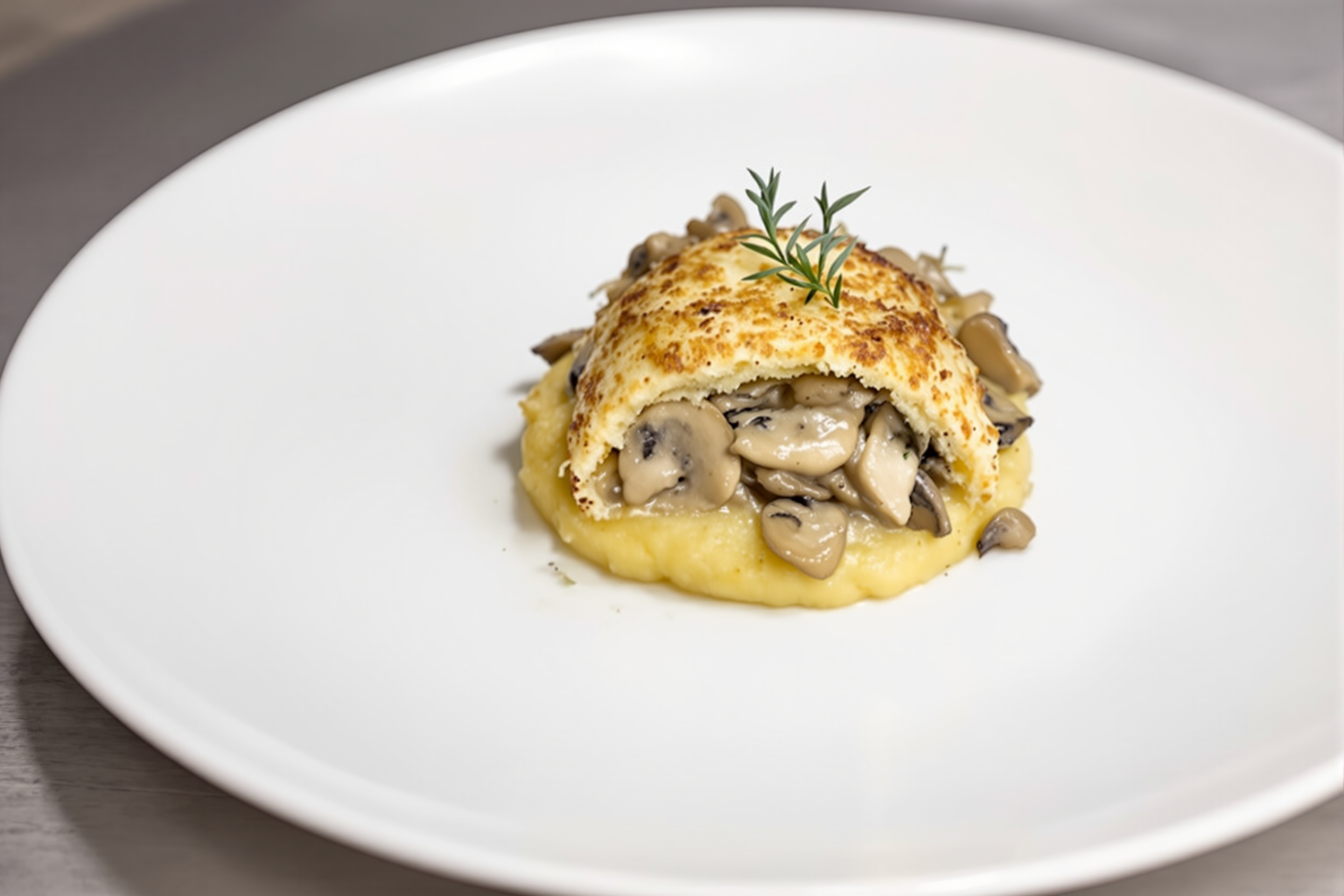
Creamy mushroom-thyme ragout built from fresh mushrooms plus dried porcini extraction, served over crisp-fried set polenta.
PHASE A — HYDRATE PORCINI
Components
| Ingredient | Quantity | Scaling |
|---|---|---|
| Dried porcini | 15 g | 6.00% |
| Hot water (80-90 C) | 150 g | 60.00% |
| Thyme sprigs | 1 g | 0.40% |
Method
- Combine dried porcini, thyme sprigs, and hot water in a heatproof bowl.
- Cover and steep 20 minutes until softened.
- Lift out porcini, squeeze gently, and chop.
- Strain soaking liquid through fine mesh or coffee filter to remove grit; reserve ~280 g.
PHASE B — COOK FIRM POLENTA BASE
Components
| Ingredient | Quantity | Scaling |
|---|---|---|
| Water | 280 g | 112.00% |
| Whole milk | 80 g | 32.00% |
| Fine salt | 4 g | 1.60% |
| Coarse polenta | 110 g | 44.00% |
| Unsalted butter | 10 g | 4.00% |
| Parmesan, finely grated | 17.5 g | 7.00% |
Method
- Bring water, milk, and salt to a low boil in a heavy pot.
- Whisk in polenta in a steady stream to avoid clumping.
- Reduce to low heat and cook 35-40 minutes, stirring every 2-3 minutes, until very thick and fully tender.
- Off heat, stir in butter and Parmesan.
PHASE C — SET & PORTION POLENTA
Components
| Ingredient | Quantity | Scaling |
|---|---|---|
| Cooked polenta | from Phase B | — |
| Olive oil (for tray) | 4 g | 1.60% |
Method
- Lightly oil a shallow tray (about 2 cm depth target).
- Spread hot polenta evenly and smooth the top.
- Cool to room temperature, then chill until firm (minimum 2 hours, ideally overnight).
- Cut into rectangles, squares, or wedges for frying.
PHASE D — BUILD MUSHROOM RAGOUT
Components
| Ingredient | Quantity | Scaling |
|---|---|---|
| Olive oil | 12.5 g | 5.00% |
| Unsalted butter | 15 g | 6.00% |
| Shallot, fine dice | 40 g | 16.00% |
| Garlic, minced | 5 g | 2.00% |
| Fresh mushrooms, sliced | 250 g | 100.00% |
| Dry white wine | 25 g | 10.00% |
| Reserved porcini liquor | 140 g | 56.00% |
| Chopped rehydrated porcini | 15 g | 6.00% |
| Heavy cream | 110 g | 44.00% |
| Fresh thyme leaves | 1.5 g | 0.60% |
| Lemon juice | 4 g | 1.60% |
| Black pepper | 1 g | 0.40% |
| Fine salt | to taste | — |
Method
- Heat olive oil and butter over medium heat in a wide saute pan.
- Add shallot with a pinch of salt; sweat 3-4 minutes without browning.
- Add garlic and cook 30 seconds.
- Add fresh mushrooms and cook on medium-high heat until they release moisture and begin to brown.
- Add wine and reduce until nearly dry.
- Add reserved porcini liquor and chopped porcini; simmer until reduced by about one-third.
- Stir in cream, thyme leaves, and black pepper; simmer gently 3-5 minutes until glossy and spoonable.
- Finish with lemon juice and adjust salt.
PHASE E — FRY POLENTA & PLATE
Components
| Ingredient | Quantity | Scaling |
|---|---|---|
| Set polenta pieces | from Phase C | — |
| Neutral oil (for frying) | 17.5 g | 7.00% |
| Unsalted butter | 10 g | 4.00% |
Method
- Heat a wide pan over medium heat with neutral oil.
- Fry set polenta pieces 3-4 minutes per side until deeply golden and crisp.
- Add butter for the final minute and baste lightly.
- Drain briefly on a rack or paper.
- Plate fried polenta and spoon mushroom ragout over or alongside.
- Finish with extra thyme leaves if desired.
STRUCTURAL NOTES
- Rehydrating porcini creates a dual input: umami-rich solids plus aromatic extraction liquid.
- Thyme performs best when split: a short hot infusion in Phase A, then a fresh addition in Phase D for top-note aroma.
- Mushroom browning followed by controlled reduction concentrates glutamates while retaining enough liquid for a spoonable sauce.
- Firm, fully cooked polenta sets as starches hydrate and cool; chilling before frying improves clean edges and crust development.
FAILURE MODES
-
Symptom: Polenta falls apart during frying.
-
Likely cause: Polenta undercooked or insufficient chill/set time.
-
Corrective action: Cook until very thick and tender, then chill at least 2 hours before cutting.
-
Symptom: Mushrooms taste steamed rather than savory.
-
Likely cause: Pan overcrowding or low heat during initial saute.
-
Corrective action: Use a wide pan and cook at medium-high heat so moisture evaporates quickly.
-
Symptom: Polenta is lumpy.
-
Likely cause: Polenta added too quickly or not whisked during hydration.
-
Corrective action: Stream polenta gradually into actively whisked liquid.
-
Symptom: Fried polenta is pale and soft.
-
Likely cause: Pan not hot enough or pieces moved too early.
-
Corrective action: Preheat pan fully and allow a stable crust to form before turning.
-
Symptom: Thyme flavour is muddy or dull.
-
Likely cause: Thyme cooked too long in cream.
-
Corrective action: Add most thyme near the end and simmer briefly.