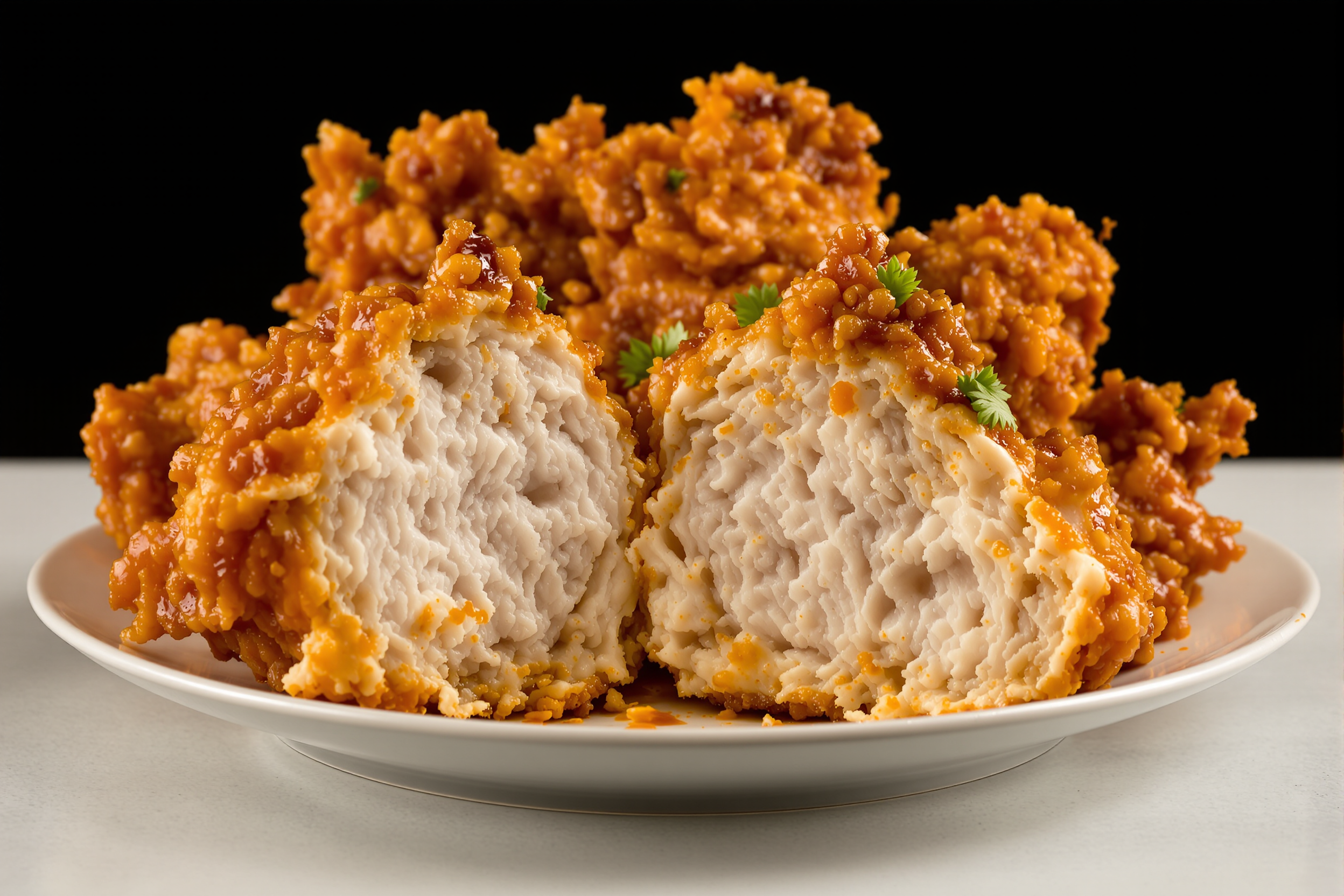
Target: double-fried endpoint (deeply golden, audibly crisp)
Primary Ingredient Basis: 500 g chicken wings or drumettes = 100%
Double-fried, starch-based coating for maximum crispness. Optimised for sauce adhesion without loss of crunch.
PHASE A — CHICKEN PREPARATION
Components
| Ingredient | Quantity | Scaling |
|---|---|---|
| Chicken wings or drumettes | 500 g | 100.00% |
| Salt | 5 g | 1.00% |
| Black pepper | 1 g | 0.20% |
| Garlic powder | 2.5 g | 0.50% |
| Rice wine or dry sherry (optional) | 7.5 g | 1.50% |
Method
- Combine chicken, salt, pepper, garlic powder, and rice wine.
- Mix thoroughly and rest 10–20 min at room temperature.
PHASE B — BATTER & COATING
Components
| Ingredient | Quantity | Scaling |
|---|---|---|
| Cornstarch | 35 g | 7.00% |
| Gluten-free flour mix (rice flour + potato starch) | 15 g | 3.00% |
| Baking powder | 1 g | 0.20% |
| Egg | 25 g | 5.00% |
| Ice-cold water or sparkling water | 60 g | 12.00% |
Method
- Combine cornstarch, gluten-free flour mix, and baking powder.
- Whisk in egg and cold water until batter is smooth and lightly runny.
- Dip chicken into batter and allow excess to drip off.
- Arrange coated chicken on rack or tray and rest 5 min.
PHASE C — DOUBLE FRY
Components
| Ingredient | Quantity | Scaling |
|---|---|---|
| Neutral frying oil | as needed | — |
Method
- Heat oil to 160 C.
- Fry chicken for 7–8 min until cooked through but pale.
- Remove and drain.
- Increase oil temperature to 185–190 C.
- Fry chicken for 2–3 min until deeply golden and audibly crisp.
- Drain thoroughly.
PHASE D — SPICY SAUCE (YANGNYEOM)
Components
| Ingredient | Quantity | Scaling |
|---|---|---|
| Gochujang | 20 g | 4.00% |
| Ketchup | 30 g | 6.00% |
| Soy sauce | 15 g | 3.00% |
| Honey or brown sugar | 22.5 g | 4.50% |
| Rice vinegar | 15 g | 3.00% |
| Garlic, finely grated | 5 g | 1.00% |
| Ginger, grated | 2.5 g | 0.50% |
| Gochugaru | 5 g | 1.00% |
| Sesame oil | 7.5 g | 1.50% |
Method
- Combine all sauce ingredients except sesame oil.
- Simmer gently for 2–3 min until slightly thickened.
- Remove from heat and stir in sesame oil.
PHASE E — FINISH
Components
| Ingredient | Quantity | Scaling |
|---|---|---|
| Fried chicken | from Phase C | — |
| Yangnyeom sauce | from Phase D | — |
Method
- Toss hot chicken in warm sauce until evenly coated.
- Serve immediately.
RELATED LINKS
Techniques
- [[Technique - Double Frying]]
- [[Technique - Sauce Reduction]]
- [[Technique - Starch Batter Coating]]
Principles
- [[Principle - Maillard Reaction]]
- [[Principle - Sauce Adhesion]]
- [[Principle - Starch Dehydration]]
- [[Principle - Textural Contrast]]
Ingredients
- [[Ingredient - Baking Powder]]
- [[Ingredient - Black Pepper]]
- [[Ingredient - Chicken Wings Or Drumettes]]
- [[Ingredient - Cornstarch]]
- [[Ingredient - Egg]]
- [[Ingredient - Fried Chicken]]
- [[Ingredient - Garlic]]
- [[Ingredient - Garlic Powder]]
- [[Ingredient - Ginger]]
- [[Ingredient - Gluten Free Flour Mix]]
- [[Ingredient - Gochugaru]]
- [[Ingredient - Gochujang]]
- [[Ingredient - Honey Or Brown Sugar]]
- [[Ingredient - Ice Cold Water Or Sparkling Water]]
- [[Ingredient - Ketchup]]
- [[Ingredient - Neutral Frying Oil]]
- [[Ingredient - Rice Vinegar]]
- [[Ingredient - Rice Wine Or Dry Sherry]]
- [[Ingredient - Salt]]
- [[Ingredient - Sesame Oil]]
- [[Ingredient - Soy Sauce]]
- [[Ingredient - Yangnyeom Sauce]]
STRUCTURAL NOTES
- Potato starch in the GF mix is critical for long-lasting crispness — it dehydrates more completely than wheat flour during frying.
- Batter temperature should remain cold until frying; cold batter hitting hot oil creates more violent steam release, building a rougher, crispier surface.
- The first fry at 160 C cooks the chicken through and sets the starch structure. The second fry at 185–190 C dehydrates the crust for lasting crunch.
- Sauce should coat, not soak — excess sauce will soften the crust. Half-sauced service preserves textural contrast.
- Sesame oil is added off heat to preserve its volatile aromatics.
FAILURE MODES
-
Symptom: Coating falls off during frying.
-
Likely cause: Batter too thick or chicken not rested after coating.
-
Corrective action: Thin batter to lightly runny consistency. Rest coated chicken 5 min before first fry.
-
Symptom: Crisp coating goes soggy within minutes of saucing.
-
Likely cause: Too much sauce, or sauce applied to insufficiently drained chicken.
-
Corrective action: Drain chicken thoroughly after second fry. Toss in sauce — do not drown. Serve immediately.
-
Symptom: Chicken is cooked through but coating is pale and soft.
-
Likely cause: Second fry skipped or oil temperature too low.
-
Corrective action: Second fry at 185–190 C is non-negotiable. Fry until deeply golden and audibly crisp.
-
Symptom: Sauce tastes harsh and one-dimensional.
-
Likely cause: Insufficient simmer time or missing acid balance.
-
Corrective action: Simmer a full 2–3 min to meld flavours. Adjust vinegar and honey for sweet-sour balance.