Primary Ingredient Basis: 250 g unsalted butter = 100%
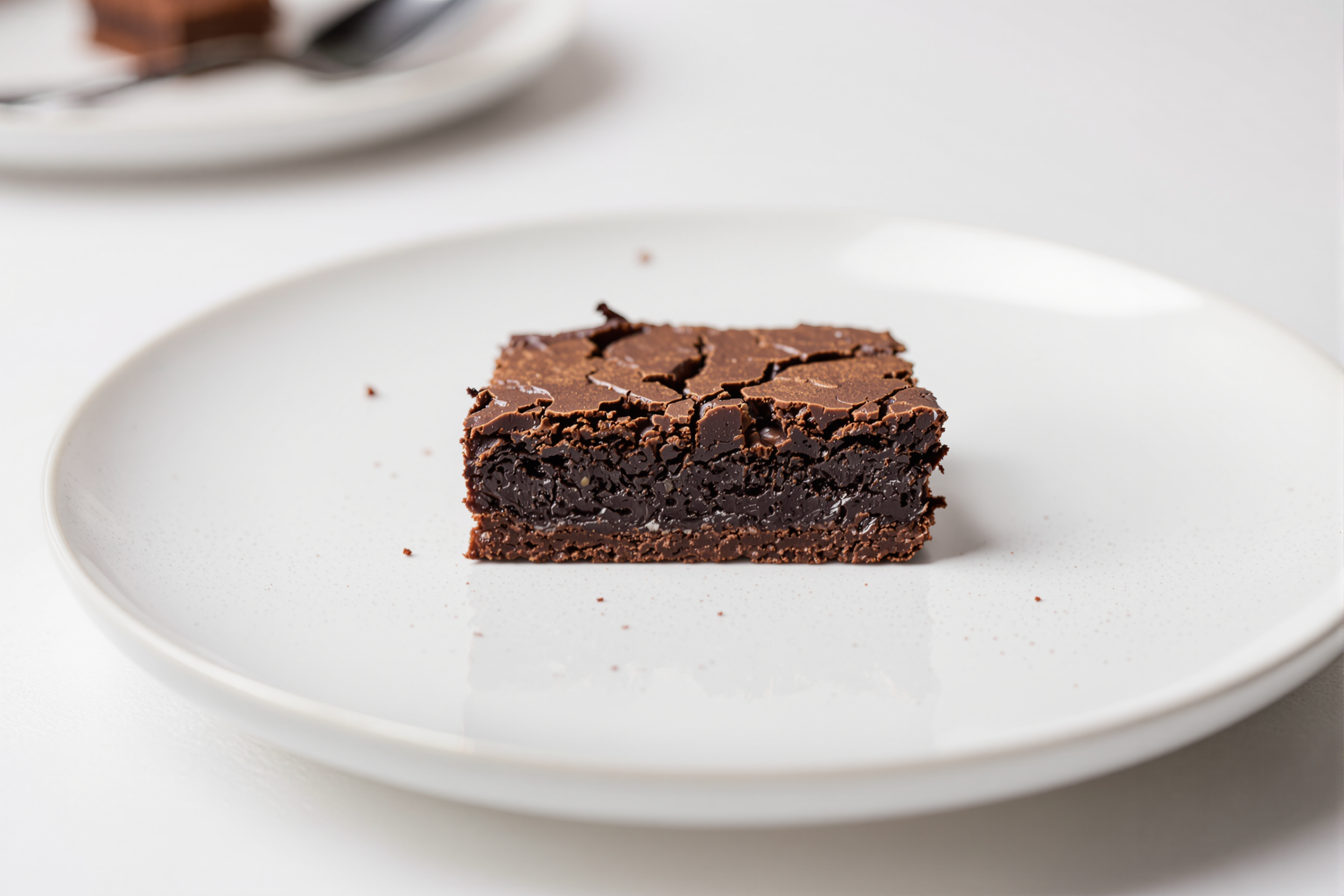
Dense matrix. Crackled surface. Controlled set.
PHASE A — MELT
Components
| Ingredient | Quantity | Scaling |
|---|---|---|
| Unsalted butter | 250 g | 100.00% |
| Dark chocolate 70% | 200 g | 80.00% |
Method
- Combine butter and chocolate.
- Melt gently to 45–50 C until smooth.
- Cool slightly before incorporation.
PHASE B — EMULSION
Components
| Ingredient | Quantity | Scaling |
|---|---|---|
| Muscovado sugar | 300 g | 120.00% |
| Eggs (large, without shell; about 4) | 200 g | 80.00% |
Method
- Whisk sugar and eggs until glossy and slightly thickened.
- Fold in melted chocolate mixture to form stable emulsion.
PHASE C — DRY INCORPORATION
Components
| Ingredient | Quantity | Scaling |
|---|---|---|
| Plain flour | 100 g | 40.00% |
| Cocoa powder | 50 g | 20.00% |
| Fine salt | 2 g | 0.80% |
| Vanilla extract | 5 g | 2.00% |
| Walnuts (optional) | 150 g | 60.00% |
Method
- Sift flour, cocoa, and salt.
- Fold gently into batter.
- Avoid overmixing to limit gluten formation.
- Add vanilla and walnuts if using.
PHASE D — BAKE
Components
| Ingredient | Quantity | Scaling |
|---|---|---|
| Prepared batter | ~1.1 kg | — |
| Pan (square or tart tin) | 20 × 20 × 4 cm square tin or 23 cm tart tin (>=2.5 cm deep) | — |
| Baking paper | as needed | — |
Method
- Preheat oven to 170 C (conventional).
- Line pan with baking paper. If using a loose-bottom tart tin, wrap the outside base and sides with foil.
- Transfer batter and level surface. Fill no more than 80–85% of tin height (this batch is ~70% fill in a 20 × 20 × 4 cm tin).
- Bake 22–30 min to internal temperature 88–92 C.
- Centre should wobble slightly when shaken.
PHASE E — SET & SLICE
Components
| Ingredient | Quantity | Scaling |
|---|---|---|
| Baked brownie slab | 1 unit | — |
Method
- Cool completely at room temperature (minimum 2 h).
- Slice with a warm, clean knife for sharp edges.
RELATED LINKS
Techniques
- [[Technique - Dry Folding]]
- [[Technique - Emulsification]]
- [[Technique - Low Temperature Baking]]
- [[Technique - Melting]]
Principles
- [[Principle - Gluten Limitation]]
- [[Principle - Protein Coagulation]]
- [[Principle - Starch Gelation]]
- [[Principle - Sugar Film Formation]]
Ingredients
- [[Ingredient - Baking Paper]]
- [[Ingredient - Cocoa Powder]]
- [[Ingredient - Dark Chocolate 70%]]
- [[Ingredient - Egg]]
- [[Ingredient - Fine Salt]]
- [[Ingredient - Muscovado Sugar]]
- [[Ingredient - Plain Flour]]
- [[Ingredient - Square Pan]]
- [[Ingredient - Unsalted Butter]]
- [[Ingredient - Vanilla Extract]]
- [[Ingredient - Walnuts]]
STRUCTURAL NOTES
- High fat and relatively low flour limit gluten development, producing a dense fudgy crumb rather than a cakey structure.
- The crackled surface forms from dissolved sugar rising and creating a thin meringue-like film during baking.
- Pulling the brownie at 88–92 C preserves internal moisture while ensuring protein coagulation and starch gelation are complete.
- Cooling is not optional — the starch and fat matrix needs time to set. Cutting early yields a gooey mess instead of clean fudgy squares.
FAILURE MODES
-
Symptom: Cakey, dry crumb with no fudge character.
-
Likely cause: Overbaked or eggs over-whipped incorporating too much air.
-
Corrective action: Pull at 88–92 C with visible wobble. Whisk eggs only to glossy, not to ribbon stage.
-
Symptom: No crackled top surface.
-
Likely cause: Sugar not fully dissolved into eggs before folding in chocolate.
-
Corrective action: Whisk sugar and eggs longer until glossy and slightly thickened — the sugar film needs dissolved sugar at the surface.
-
Symptom: Dense, greasy texture with no structure.
-
Likely cause: Chocolate mixture too hot when combined with eggs, breaking the emulsion.
-
Corrective action: Cool chocolate-butter mixture to ~45 C before folding into egg-sugar base.