Target Serving Temperature: 18–20 C (cool room temperature)
Primary Ingredient Basis: 100 g aged Manchego = 100%
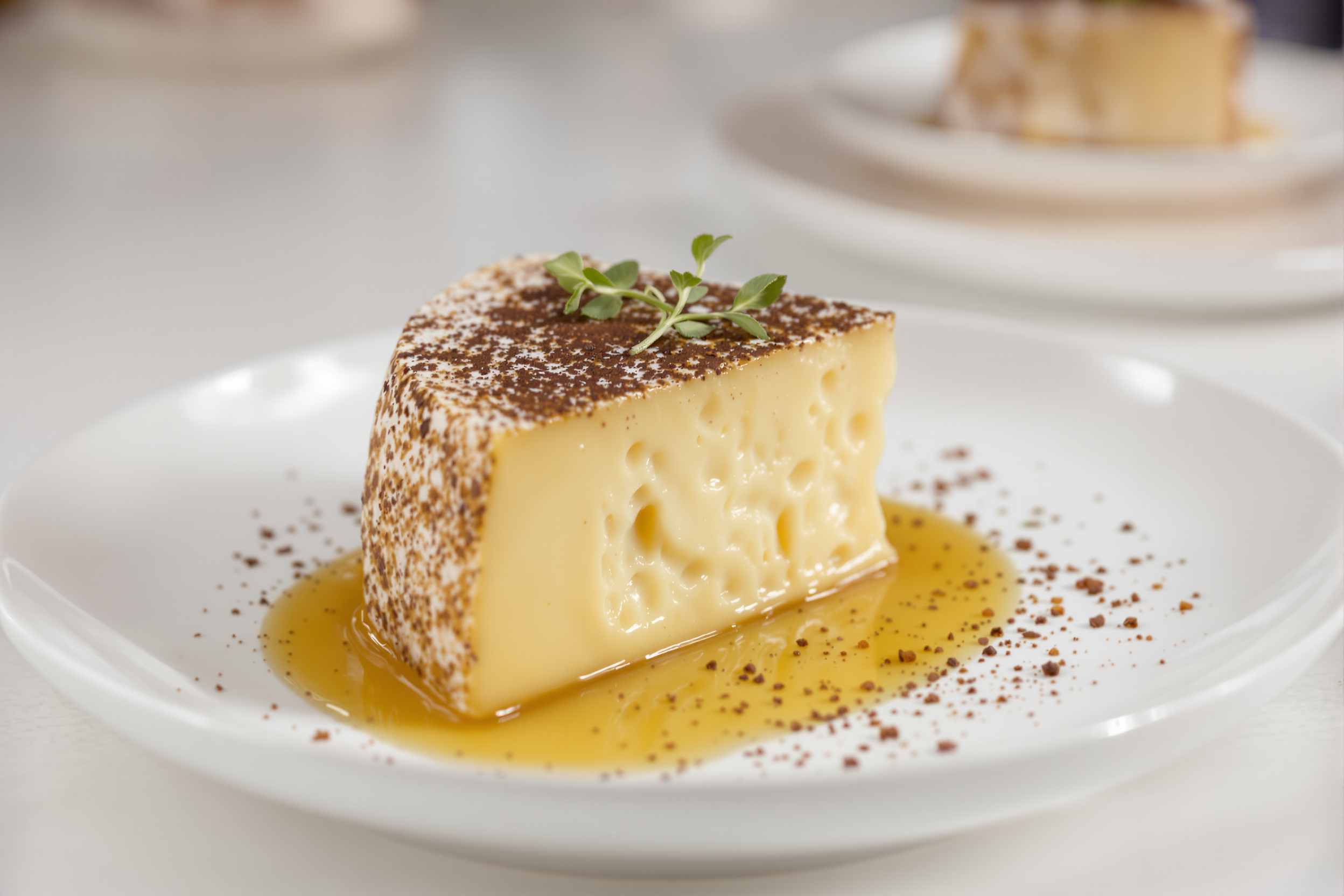
Sweet–bitter contrast plate. Best served at cool room temperature.
PHASE A — CHEESE PREPARATION
Components
| Ingredient | Quantity | Scaling |
|---|---|---|
| Aged Manchego (12+ months) | 100 g | 100.00% |
Method
- Remove Manchego from refrigeration 45–60 min before serving.
- Slice into 5–7 mm wedges or thick shards. Arrange on a neutral plate.
PHASE B — THYME HONEY
Components
| Ingredient | Quantity | Scaling |
|---|---|---|
| Good-quality honey (wildflower preferred) | 30 g | 30.00% |
| Fresh thyme leaves | 1 g | 1.00% |
Method
- Warm honey gently to 40–45 C (just fluid, not hot).
- Stir in thyme leaves and allow to infuse 10–15 min.
- Strain or leave leaves in for a rustic finish.
- Goal: aromatic lift without cooked-herb bitterness.
PHASE C — COFFEE DUST
Components
| Ingredient | Quantity | Scaling |
|---|---|---|
| Whole coffee beans (medium roast) | 2.5 g | 2.50% |
Method
- Grind coffee beans very fine, almost powder.
- Sift through a fine sieve to remove coarse particles.
- Use sparingly — think seasoning, not crust.
PHASE D — FINISH AND ASSEMBLY
Components
| Ingredient | Quantity | Scaling |
|---|---|---|
| Prepared Manchego | from Phase A | — |
| Thyme honey | from Phase B | — |
| Coffee dust | from Phase C | — |
Method
- Drizzle warm thyme honey lightly over or beside the cheese.
- Dust with a restrained pinch of coffee powder.
- Serve immediately.
RELATED LINKS
Techniques
- [[Technique - Fine Grinding]]
- [[Technique - Infusion]]
- [[Technique - Sifting]]
Principles
- [[Principle - Aromatic Infusion]]
- [[Principle - Flavour Threshold Management]]
- [[Principle - Sweet Bitter Contrast]]
Ingredients
- [[Ingredient - Aged Manchego]]
- [[Ingredient - Coffee Dust]]
- [[Ingredient - Fresh Thyme Leaves]]
- [[Ingredient - Good Quality Honey]]
- [[Ingredient - Thyme Honey]]
- [[Ingredient - Whole Coffee Beans]]
STRUCTURAL NOTES
- The coffee should read as a whisper of roast, not a headline. If the bitterness dominates, you’ve used too much.
- Medium roast works better than dark — dark roast tastes like carbon and regret.
- Aged Manchego (12+ months) is essential; young cheese lacks the crystalline texture and concentrated flavour needed to stand up to the bitterness.
- Warming honey to 40–45 C increases fluidity and volatilises thyme aromatics without degrading flavour compounds. Exceeding 50 C risks cooked-herb bitterness and dulled floral notes.
- Coffee dust operates below conscious flavour threshold — it should register as roast complexity, not as coffee per se.
FAILURE MODES
-
Symptom: Coffee flavour dominates the plate.
-
Likely cause: Excessive coffee dust or grind too coarse (larger particles deliver more concentrated hits).
-
Corrective action: Reduce to a bare pinch; sift more aggressively to remove coarse particles.
-
Symptom: Honey tastes flat or cloying.
-
Likely cause: Honey not warm enough to volatilise thyme aromatics, or infusion time too short.
-
Corrective action: Warm to 40–45 C and infuse a full 15 min. Use wildflower or thyme-origin honey for better baseline complexity.
-
Symptom: Cheese tastes rubbery and muted.
-
Likely cause: Served too cold — fat crystallisation suppresses flavour release and texture.
-
Corrective action: Ensure full 45–60 min tempering at room temperature before serving.
OPTIONAL REFINEMENTS
- Add a tiny flake of sea salt to sharpen contrast.
- Try blooming the coffee powder in a dry pan for 20 seconds to soften acidity.
- A dry fino sherry alongside this is outrageously good.